|
High above all the fun and frivolity stands Christ the Redeemer with outstretched arms. During the four days leading up to Lent, a righteous party known as Carnaval rages in Rio de Janeiro. The Cariocas drink,dance, and kick up their heels in lusty celebration. Rational, normal time
is suspended and problems are forgotten or confronted.
The origins of Rio Carnaval are contested due to the nature of Brazilian cultural influence. Some postulate that the festivities sprang from
an ancient Greek festival honoring Dionysus, Olympian God of wine,
pleasure and festivity. He is counter to Apollo the Sun God of clarity;
his appeal is not made to the reasoning mind but rather directly
to human chaotic emotion. Portuguese immigrants from the isles of Acores,
Madeira and Cabo Verde introduced the Entrudo to Brazil in 1723.
By 1800 religious processions grew in size and festive celebrations
on the streets spread to all neighborhoods.
Naturally, the concepts of Carnaval evolved as time elapsed.
Toward the end of the 1800s, during the years of military censorship, Carnaval garnered socio-ideological influence. To express their dissatisfaction of repression and desire for liberty, repressed participants of the Samba Schools incorporated irony and sarcasm
into their performance. Samba became an integral part of Rio Carnaval following the abolition of slavery in 1888. The Samba phenomenon has
become a great tool for Brazilian unification, as it knows no class divide.
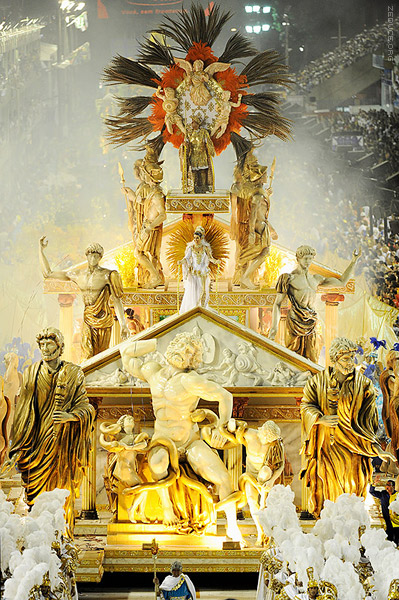
The parade through the enormous Sambodromo is surely the climax
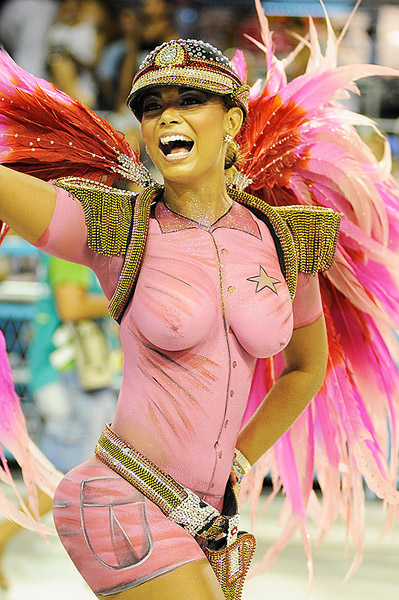
of Carnaval. Scantily clad, vivacious females of 12 distinct Samba schools gyrate atop ornate floats in an exquisite procession.
The Queens are responsible for conquering the spectators’ hearts
and accumulating points from a panel of 40 judges. The Porta Bandeira,
flag bearer, is protected by the Mestre Sala who guides and watches over her as she dances the parade route, guarding her with a knife to deter
any competitor’s ill intentions.
When it is genuinely celebrated, Carnaval frees men and women from
the restrictions of everyday life. Fools dress as wise men; servants
as masters; celebrants of all social classes rub elbows in the street, protected behind the security of masks. It is a temporary abandonment
to fantasy, an unspoken negation of the status quo. Each year King Momo
is crowned on the Friday preceding Lent, and the crowd erupts with jubilation. As king of Carnaval, the corpulent Momo embodies all
the jollity and excess associated with Brazilian bacchanals.
According to Greek mythology, when ejected from Olympus King Momo
settled in Rio. Never was there a more contented cast away King.
- Elizabeth Katharine James
|
|
 |
 |
 |
|
|